
A monthly budget you can actually follow uses realistic income, evidence of where your money goes, room for costs that do not happen every month, and a simple routine for tracking and adjusting the plan.
Treat the first version as a baseline built from the best information available. It does not need perfect category limits, but the total must fit within the monthly income you can reasonably plan around. If that amount is $4,000, your bills, everyday spending, savings, debt payments, and reserved money must add up to $4,000 or less.
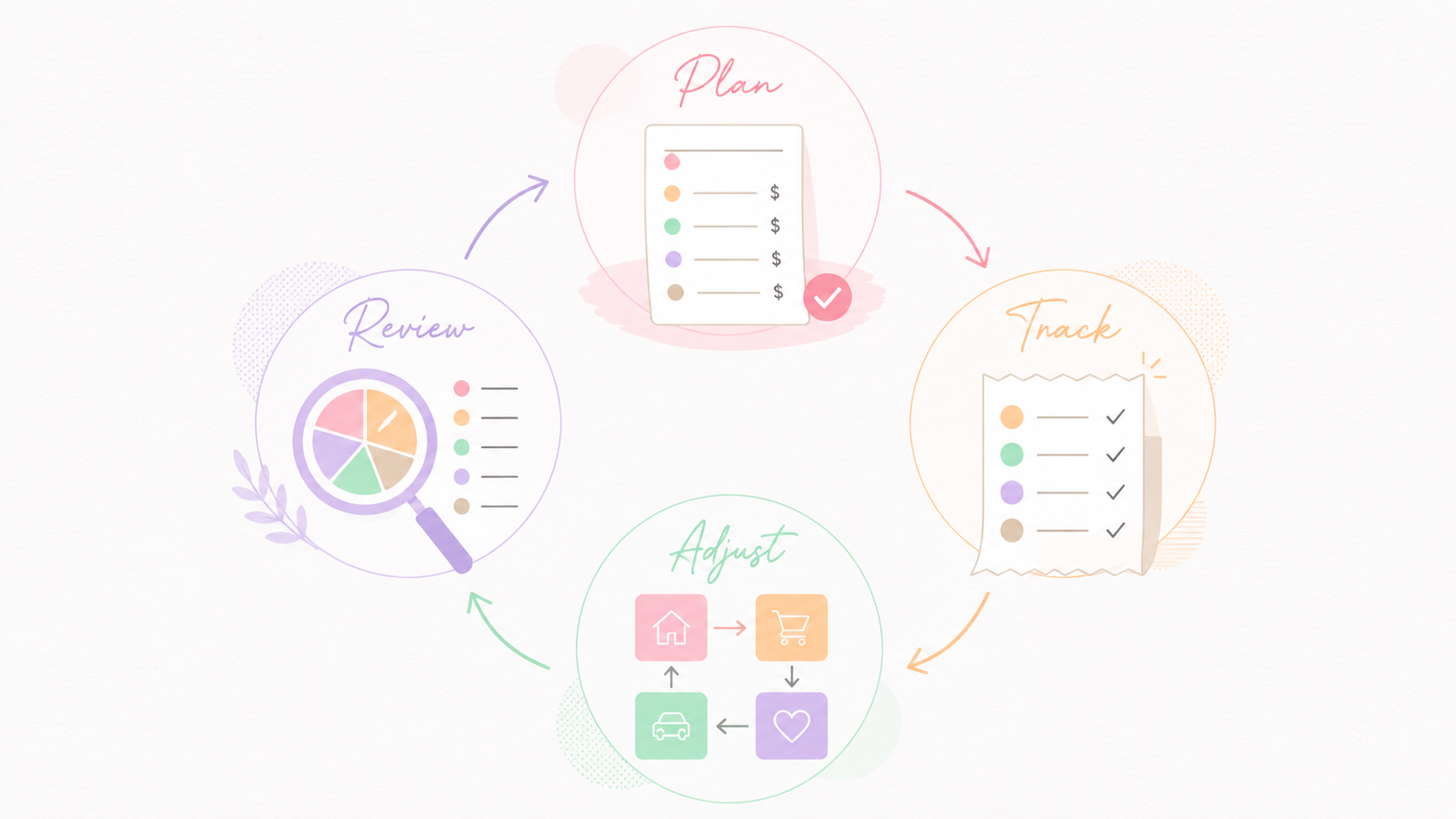
The process has three parts:
- Build the baseline: Calculate usable monthly income, list required bills, estimate everyday spending, and include irregular costs and goals.
- Track and adjust: Compare the budget with actual spending and make visible tradeoffs as you go.
- Review and refine: Use actual income and spending to improve the same reusable monthly budget over time.
Changing a category is not the same as ignoring the budget. A useful adjustment keeps the total plan intact and shows which priority will receive less money.
Build Your Monthly Budget in Seven Steps
Step 1: Gather Recent Records
Start with a realistic monthly baseline rather than an unusually cheap or expensive month. The goal is to represent the income and expenses you normally need the budget to handle.
Gather:
- Recent pay information
- Current bills
- Two or three months of bank transactions
- Two or three months of credit-card transactions
- Notes about occasional costs that should receive a monthly set-aside
Statements help uncover expenses that memory can miss, including renewals, regular household purchases, and small repeated transactions. You do not need to organize every purchase yet. The goal is to collect enough evidence to choose realistic starting amounts.
Step 2: Calculate Usable Monthly Income
Next, list every reliable source of monthly income. Use the amount available after deductions, because that is the money available for the budget. Include wages, reliable side income, benefits, support payments, and other recurring sources.
| Income | Typical monthly amount |
|---|---|
| Paycheck income | $4,000 |
| Total usable income | $4,000 |
This budget can be built around $4,000.
If your income changes, review recent history and choose a cautious monthly amount. Avoid building essential commitments around an unusually strong result. A typical recent amount may work when pay changes only slightly. When income is highly uneven, use a lower amount you can reasonably expect and adjust your spending decisions if more arrives.
There is no single estimate that works for every irregular-income situation. The useful number depends on how widely your income changes, what recent months show, and which income is dependable enough to support required bills.
Step 3: List Required Bills
Begin with the commitments that must be covered during the month. Use clear names rather than grouping everything under a label such as “fixed expenses.”
Include costs such as:
- Rent or mortgage
- Utilities, phone, and internet
- Insurance
- Minimum debt payments
- Car payments, transit passes, or other required transportation costs
- Childcare
- Other obligations you must pay
Write the monthly amount beside each major bill:
| Bill | Monthly amount |
|---|---|
| Rent | $1,200 |
| Car payment | $300 |
| Insurance | $150 |
If a bill changes slightly each month, use the expected amount or a realistic estimate based on recent bills. Do not lower a required cost just to make the budget appear balanced.
Step 4: Estimate Everyday Spending
Once the required bills are visible, estimate spending that changes throughout the month. Start with a short list of broad categories:
- Groceries
- Fuel or public transit
- Household purchases
- Eating out
- Entertainment
Review the previous two or three months of transactions and total the spending in each category. Small, repeated purchases are easy to overlook when estimating from memory, but together they can change the category total significantly.
Look for a normal range rather than the lowest number you can find. Suppose your recent grocery totals were:
- Month 1: $610
- Month 2: $640
- Month 3: $650
A $400 grocery limit is unlikely to be a useful first estimate unless you already have a specific plan for changing what you buy. A starting amount near the observed pattern—perhaps $640—gives you a plan you can test and refine.
Keep the category list simple. One “eating out” category may be enough instead of separate categories for coffee, lunch, takeout, and restaurants. Add a custom category when seeing the spending separately would affect a decision. For example, separating pet care can be useful when an upcoming veterinary cost needs its own plan.
Step 5: Make Room for Irregular Costs
The next step is to include costs that are real but do not arrive every month. Review recent records and the upcoming calendar for expenses such as:
- Annual memberships or service fees
- Birthdays, holidays, and gifts
- Car maintenance or registration
- School supplies and activity fees
- Medical and dental costs
- Seasonal clothing, travel, or home expenses
When you know the annual total, divide it by 12 to create a monthly target.
$600 annual bill ÷ 12 months = $50 per month
Add $50 to the appropriate category in your monthly budget and keep the reserved money available for that bill. Including the amount only works if it is not repeatedly redirected to unrelated spending.
When the future total is uncertain, use past spending and known events to choose a reasonable starting amount. You may not know exactly what car maintenance will cost, but planning something based on recent history is more useful than assuming the cost will be zero.
Step 6: Add Savings, Extra Debt Payments, and a Buffer
After required bills, everyday spending, and irregular costs are visible, add deliberate lines for savings or payments above your required debt minimums. Keep the goals concrete and sustainable. Examples include:
- $100 toward an emergency reserve
- $50 toward a future trip
- $75 above the required payment on one debt
These amounts become part of the plan instead of depending on money happening to remain at the end of the month. No universal percentage is required; the useful amount is one that fits after your actual obligations are accounted for.
Finally, add a small miscellaneous or buffer category for ordinary costs you did not predict, such as a replacement charger or an unexpected school contribution. Keep it limited and review what uses it. If the same type of purchase repeatedly comes from the buffer, give that expense a clearer category or a more realistic monthly amount.
Step 7: Make the Total Fit and Assign the Remainder
Add every planned use of money: required bills, everyday spending, irregular costs, savings, extra debt payments, and the buffer. Compare the result with the monthly income you chose.
Here is the first version of the $4,000 example:
| Planned use | Amount |
|---|---|
| Required bills | $2,400 |
| Everyday spending | $950 |
| Irregular costs | $250 |
| Savings or extra debt payments | $300 |
| Total planned so far | $3,900 |
The calculation is:
$4,000 income − $3,900 planned uses = $100 unassigned
Give the remaining $100 a purpose:
- Put $75 in the buffer for ordinary forgotten costs.
- Add $25 to the current savings or debt priority.
The completed plan becomes:
| Planned use | Amount |
|---|---|
| Required bills | $2,400 |
| Everyday spending | $950 |
| Irregular costs | $250 |
| Savings or extra debt payments | $325 |
| Buffer | $75 |
| Total planned | $4,000 |
Assigning the remainder does not make the plan rigid. It establishes what the money is meant to do, so any later tradeoff will be visible.
If planned uses are higher than income, work through the difference in order:
- Confirm the numbers. Correct estimates that are genuinely too high, but keep required bills at their real amounts.
- Reduce lower-priority flexible spending. Begin with categories where choices remain possible, such as entertainment or eating out.
- Delay a non-urgent goal or purchase. Wait until your available money can support it.
- Adjust extra payments before required payments. Keep debt minimums and other required commitments accurate.
- Identify any remaining income gap. If realistic costs still exceed expected income, the problem is larger than one category and requires a broader decision about expenses, income, or both.
Do not make the plan appear balanced by entering numbers you already know are unrealistic or by planning to miss required payments.
Use a 10-Minute Weekly Routine
The budget becomes useful when you compare it with what you actually spend. A short weekly review is enough to keep the numbers current and notice a category that needs attention while you still have choices.
The 10-minute weekly budget check
Choose one consistent day each week and complete four tasks:
- Check recent transactions. Add anything missing and correct inaccurate amounts or categories.
- Review the important categories. Compare each planned amount with actual spending and the amount remaining.
- Look ahead. Note any necessary or higher-cost purchases you expect before the next review.
- Make one or two adjustments. Move money where the budget no longer matches what you need.
Focus on categories where a decision is still possible, such as groceries, transportation, eating out, household purchases, the buffer, and upcoming irregular costs. The review should help you make decisions, not become a lengthy bookkeeping session.
Use the remaining amount, not only the amount already spent. If the grocery plan was $640 and $400 has been spent, then $240 remains. With three weeks left:
$240 remaining ÷ 3 weeks = about $80 per week
That is a guide, not a requirement that every week be identical. If one week needs a larger grocery trip, check whether the following weeks can be lower or decide which other category can cover the difference.
You do not need to watch the budget constantly. Add one extra check before a high-spending decision, such as a large household purchase, a weekend away, or an expensive meal. Looking at the remaining amounts first makes the tradeoff clear while there is still time to choose.
What to Do When a Category Goes Over Budget
When a category goes over, do not erase the purchase, hide it, or move it to an inaccurate category. Use this rule:
- Update the actual amount. Keep an accurate record of what happened.
- Choose what will absorb the difference. Use a lower-priority category, the buffer, or a goal that can be reduced temporarily.
- Record the tradeoff. Lower one planned amount and increase the other so the full plan still fits expected income whenever possible.
- Review the original estimate. Decide whether the overage was unusual or likely to happen again.
Suppose eating out is $40 over plan. You could move $40 from entertainment or the buffer. If entertainment had $100 remaining, it now has $60. The restaurant purchase stays visible, and its effect on the rest of the month is clear.
If no category, buffer, or goal can safely absorb the overage, leave the gap visible. Accurate numbers are more useful than a budget that appears balanced only because the difference has been hidden.
The cause determines what happens next. A restaurant meal during an unusual event may not require a permanent increase. If groceries go over repeatedly during ordinary shopping, however, the grocery estimate is probably too low. Increase the monthly grocery amount and decide which other planned use will receive less.
Use Fleur to keep the cycle visible
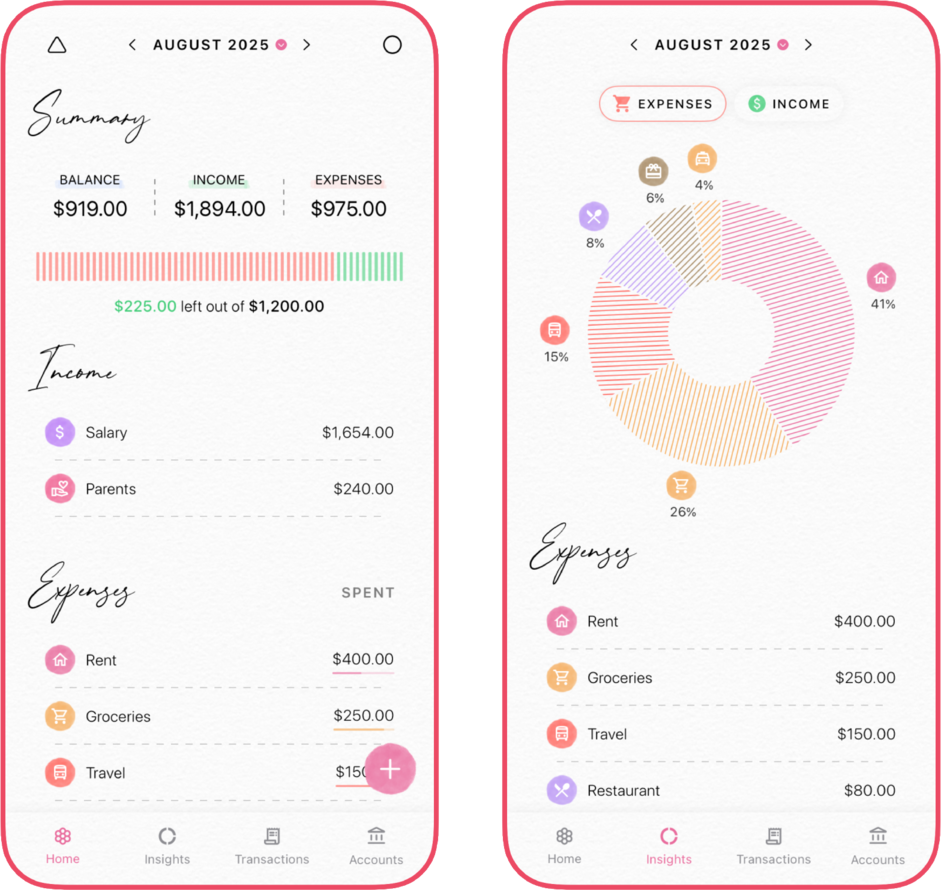
The same plan-track-adjust cycle can be managed on paper, in a spreadsheet, or in a budgeting tool. If you want the plan and actual results together, you can use the Fleur app to create one reusable monthly budget with a small set of custom categories, record expenses and income, and add repeating transactions for regular activity.
As the month progresses, compare planned amounts with actual spending and use category insights to identify patterns that need a decision. The purpose is not to create more categories; it is to keep the remaining amounts and tradeoffs easy to see.
Use What You Learn to Improve Your Monthly Budget
Review the budget after you have enough recent activity to see what actually happened. Do not judge it by whether every category matched exactly. Look for estimates that worked, differences that need attention, and information that will improve the reusable plan.
Ask four questions:
- Where did actual income or spending differ from the plan?
- Was the cause unusual, or is it likely to repeat?
- Which categories need new planned amounts?
- Which non-monthly cost needs a monthly set-aside?
Update the existing monthly budget from those answers. Raise amounts that were repeatedly too low, lower amounts that were consistently unnecessary, and make room for a new recurring bill or irregular-cost target. One unusual purchase does not require a permanent change; repeated patterns usually deserve one.
Fix the part that made the budget difficult to follow
- The budget has too many categories: Combine categories that do not lead to different decisions.
- The limits were chosen without evidence: Review recent transactions and set amounts closer to ordinary spending.
- Irregular expenses keep becoming surprises: Add a monthly amount for the missed cost and begin reserving money for it when possible.
- Transaction recording has fallen behind: Catch up from your transaction history during the next weekly review, then continue with the routine.
- One category went over: Adjust another remaining category, the buffer, or a goal instead of discarding the whole plan.
Use a minimum viable budget when you feel overwhelmed
A useful budget does not need dozens of categories. Begin with only:
- Expected income
- Required bills
- Groceries and transportation
- Minimum debt payments
- One savings goal
- Irregular costs
- A small buffer
This version still shows whether the month fits within expected income and where the main tradeoffs are. Add another category later only when it improves a decision or makes an important cost easier to plan.
Your Monthly Budget Checklist
- Gather recent pay records, current bills, and two or three months of bank and credit-card transactions.
- Enter a realistic monthly income amount after deductions.
- List required bills with their monthly amounts.
- Estimate groceries, transportation, household purchases, and other everyday spending from recent transactions.
- Add monthly amounts for annual bills and other irregular costs.
- Include one modest savings goal or extra debt payment.
- Add a limited buffer for ordinary forgotten expenses.
- Reduce, delay, or reassign lower-priority items until the total fits expected income.
- Check transactions and remaining category amounts once a week.
- Check the plan again before a major spending decision.
- Use repeated differences between planned and actual spending to refine the same monthly budget.